
 中文(繁體字)
 English (international)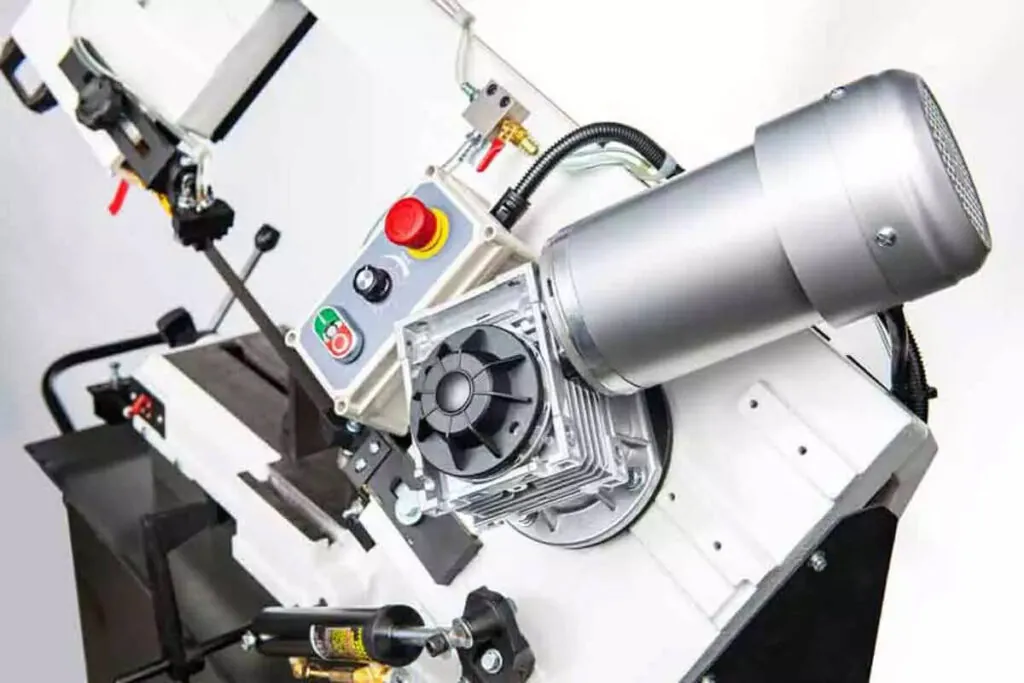
Definition of Band Saw Motor Power Rating
An undersized motor will stall or trip under heavy cuts, while an oversized motor represents unnecessary capital and energy cost. Correct motor selection requires matching rated power output to the maximum anticipated material cross-section, feed force demand, and duty cycle requirements of the application.
Why it matters for Band Saw and Mill Drill Machines
Power rating also governs duty cycle capability. Machines rated for continuous heavy cutting require motors with adequate thermal mass and cooling capacity, typically TEFC (totally enclosed fan-cooled) motors with a service factor of 1.15 or higher. A band saw operating consistently near its motor's rated limit will experience reduced motor life and increased downtime when thermal protection systems engage during production cycles.
When evaluating band saw motor power rating for a specific application, consider both peak power demand and starting torque requirements, as well as the available power supply infrastructure. Three-phase motors deliver more consistent torque than single-phase equivalents at equivalent power ratings. Variable frequency drive controls, increasingly standard on production band saws, allow fine blade speed adjustment and provide motor protection functions including overload detection and controlled ramp-up that extend motor service life.
Related Terms
blade speed rangecutting capacity
variable frequency drive
motor torque
feed rate
spindle power
FAQ
What power ratings are typical for industrial band saw motors?
Industrial band saw motor power rating varies significantly by machine class and application. Light-duty production band saws for non-ferrous or small-section cutting typically use motors in the 1.5 to 3 kW range. Mid-range machines designed for structural steel, solid bar stock, or tube cutting commonly specify motors between 3 kW and 7.5 kW. Heavy-duty production band saws cutting large cross-sections of alloy steel or structural profiles may require motors from 11 kW to 22 kW or higher. The band saw motor power rating should be matched to the maximum material cross-section and required production throughput, with a service factor of at least 1.15 recommended for continuous production environments to provide an operating margin above rated load.
How does band saw motor power rating affect blade speed under cutting load?
Band saw motor power rating directly determines the machine's ability to maintain programmed blade speed as cutting resistance increases with wider cross-sections or harder materials. As blade-material contact increases, the torque demand on the band saw motor rises proportionally. A motor operating near its rated power will experience blade speed drop under these conditions, reducing cutting efficiency and increasing heat generation in the blade body. Maintaining a power margin of 20 to 30 percent above calculated peak demand ensures the band saw motor sustains blade speed throughout the cut. Consistent speed drop during cutting is a reliable indicator that the motor power rating is insufficient for the material or section being processed and the application specification should be re-evaluated.
How should band saw motor power rating be evaluated when upgrading to cut harder or larger-section materials?
Evaluating band saw motor power rating for an upgraded application requires calculating expected cutting force and comparing it to the current motor's output capacity. Determine the material's specific cutting resistance in N/mm² and the blade's maximum chip load per tooth at the intended feed rate. Multiply these values by the blade contact width and number of teeth simultaneously engaged to estimate peak torque demand. If calculated demand exceeds 80 percent of the current band saw motor power rating at rated speed, an upgrade is warranted. Verify that the machine frame, gearbox, and blade guide system are also rated to handle the increased forces that accompany a higher-powered motor before committing to the upgrade, as these subsystems may impose separate capacity limits.