
 中文(繁體字)
 English (international)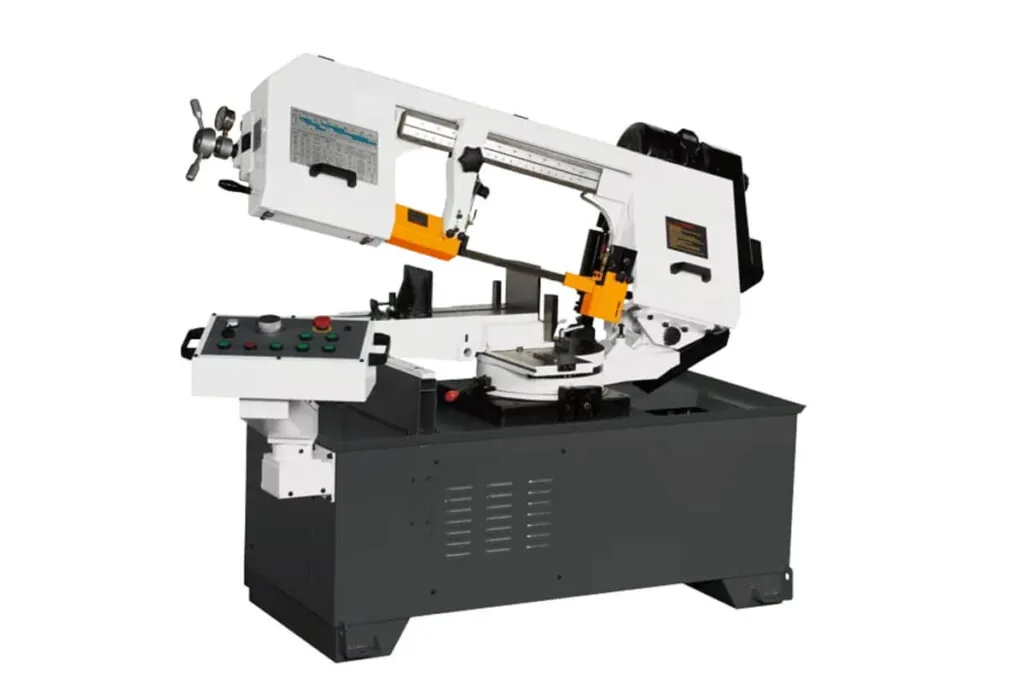
Definition of Band Saw Frame Rigidity
Why It Matters for Band Saw and Mill Drill Machines
Related Terms
Cutting Tolerance, Blade Deflection, Guide Alignment, Vibration Dampening, Machine Base, Column DesignFAQ
How rigid is the frame design of a horizontal band saw?
Horizontal band saw frame rigidity varies significantly across machine classes and construction methods. Entry-level machines use welded steel tube frames offering basic rigidity suitable for general fabrication. Industrial horizontal band saws feature cast iron or heavily ribbed fabricated steel construction providing substantially higher stiffness. Premium production saws incorporate stress-relieved castings, box-section columns, and reinforced pivot assemblies that minimize deflection under maximum feed pressure. Frame rigidity is measured through static deflection tests under rated cutting load, with quality machines deflecting less than 0.002 inches at the blade guides. Evaluating rigidity requires comparing machines under equivalent loading conditions rather than relying solely on weight specifications.
What factors cause band saw frame rigidity to degrade during service?
Band saw frame rigidity degrades through several mechanisms during extended service. Bolted joints loosen from vibration, allowing micro-movement that accumulates into measurable deflection. Cast components develop stress cracks at high-load transition areas, particularly around pivot points and column bases. Thermal cycling from intermittent operation causes differential expansion that stresses welded joints. Corrosion from coolant contact weakens structural sections over time. Impact damage from workpiece handling creates local deformation affecting geometric accuracy. Frame rigidity degradation manifests as increased vibration, wandering cuts, and difficulty maintaining tolerances. Preventive maintenance including joint torque verification, crack inspection, and alignment checks identifies degradation before production quality suffers.
How does frame rigidity affect band saw blade life and cutting performance?
Frame rigidity directly influences band saw blade life by controlling deflection amplitude during cutting. Rigid frames maintain consistent blade tension and guide positioning, allowing teeth to engage material at designed angles. Flexible frames permit blade flutter that causes uneven tooth loading, accelerating wear on leading teeth while leaving trailing teeth underutilized. Dynamic deflection generates cyclic stress that initiates fatigue cracks in blade backs. Poor rigidity also degrades cutting performance through increased vibration, rougher surface finish, and wider kerf variation. Production data consistently shows blade life improvements of 20-40% when upgrading from light-duty to industrial-grade frames while maintaining identical operating parameters and blade specifications.